An observation of how the non-profit organisation uses a digital communications management strategy to save lives.
To watch https://youtu.be/ws2Im1OO0Wo
Social media strategies and tips for authentic, effective online communication.

Digital communications has rapidly evolved from a niche specialty into the backbone of modern business communication. As traditional marketing channels shift to digital-first strategies, Australian organisations increasingly demand professionals skilled at navigating complex digital ecosystems to deliver measurable results. Wondering what roles and career paths are out there in digital communications? This guide breaks them down for you.
Key Digital Communications Roles
Digital Communications Manager
Salary: $110,000 – $160,000 annually
Core Responsibilities:
Social Media Manager
Salary: $80,000 – $95,000 annually
Core Responsibilities:
Content Marketing Specialist
Salary: $65,000 – $85,000 annually
Core Responsibilities:
Digital Marketing Coordinator
Salary: $70,000 – $80,000 annually
Core Responsibilities:
Digital Communications Officer (Government)
Salary: $75,000 – $95,000 annually
Core Responsibilities:
Professional Development and Recognition
Australian Marketing Institute (AMI)
The Australian Marketing Institute provides professional development through their globally aligned competency framework covering 25 core marketing competencies and 8 specialised digital competencies. Professionals can pursue Certified Practising Marketer (CPM) designation and access over 100 courses mapped to specific competencies.
Communication and Public Relations Australia (CPRA)
Communication and Public Relations Australia serves as the national industry body for PR and communication professionals. CPRA offers specialised training programs, networking opportunities with 23,000+ industry professionals, and professional development through masterclasses and conferences.
Current Market Opportunities
Australia’s digital communications job market is robust and expanding. Recent data shows over 5,000 digital communications positions available nationwide, with digital communication specialists earning an average of $135,000 per year.
Essential Skills Development:
Conclusion
Australia’s digital communications landscape offers exceptional career opportunities that blend creative storytelling with analytical thinking. With salaries ranging from $57,000 for entry-level coordinators to $160,000+ for senior managers, the sector provides clear progression pathways and competitive compensation. Success requires continuous learning, professional certification through AMI and CPRA, and staying current with evolving digital trends.
The market is especially vibrant, particularly in government digital transformation and e-commerce sectors, making it an ideal time to enter or advance within this dynamic field.
Make your move today!
Industry sources
AdNews. (2019, July 10). The marketing roles and skills in demand in Australia. AdNews. https://www.adnews.com.au/news/the-marketing-roles-and-skills-in-demand-in-australia
Australian Direct Marketing Association. (2022, November 24). Marketing 2025: The future of skills and technology. ADMA. https://www.adma.com.au/resources/marketing-2025
B&T Magazine. (2025, March 10). Revealed! B&T’s CMO Power List 2025. B&T. https://www.bandt.com.au/revealed-bts-cmo-power-list-2025/
CareerFoundry. (2024, February 6). 9 essential digital marketing skills to develop in 2025. CareerFoundry Blog. https://careerfoundry.com/en/blog/digital-marketing/digital-marketing-skills/
Marketing Mag. (n.d.). Australian marketing news, trends and resources. Marketing Mag. https://www.marketingmag.com.au/
Queensland University of Technology. (n.d.). Master of digital communication. QUT. https://www.qut.edu.au/courses/master-of-digital-communication
Robert Half. (2025, April 24). Top trends in digital marketing for 2025: Expert insights for the year ahead. Robert Half. https://www.roberthalf.com/gb/en/insights/career-development/top-trends-in-digital-marketing-for-2025-expert-insights
Sprout Social. (2025). Social media trends in Australia [updated 2025]. Sprout Social. https://sproutsocial.com/insights/social-media-trends-australia/
Photo by Anna Shvets: https://www.pexels.com/photo/crop-woman-typing-on-laptop-5711948/
Making complex ideas simple and beautiful.
Australia’s digital scene is about to undergo a seismic shift. With the world’s first social media age restriction of 16+ taking effect this December, social media platforms are scrambling to adapt. But before the dust settles, let’s dive into how these digital giants stack up against each other – and what it means for Australian users.
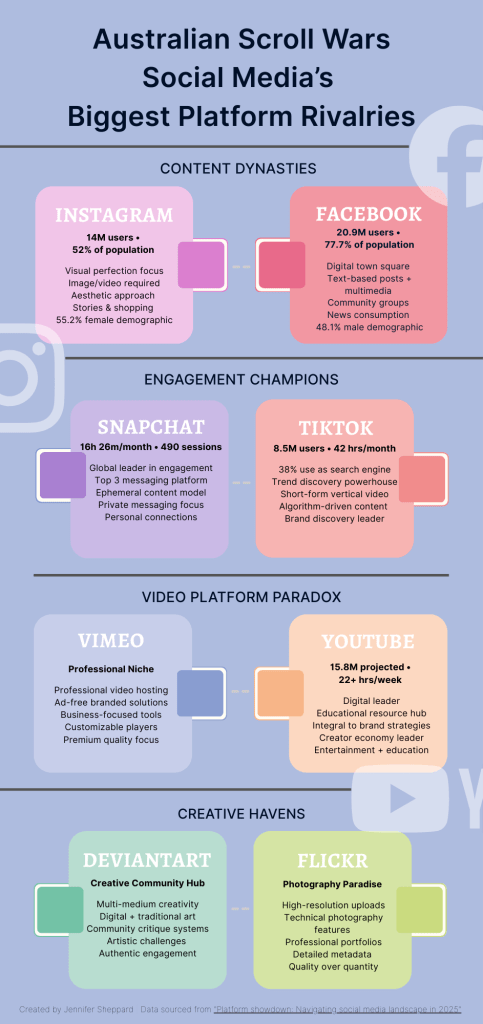
Talk about sibling rivalry with a twist! These Meta-owned platforms dominate Australian social media but serve remarkably different purposes. Facebook commands 20.9 million Australian users (77.7% of the population), while Instagram captures 14 million users, representing 52 per cent of Australians who clearly can’t get enough of perfectly curated feeds.
What they share: Being part of the Meta family means shared DNA. Both platforms face the December age restrictions and both must implement sophisticated age verification systems or risk fines up to $49.5 million. They’re increasingly similar too, with Facebook’s Reels directly mimicking Instagram’s success. Both platforms integrate Stories, shopping features, and cross-platform messaging.
Where they differ: Facebook remains the digital town square – it’s where Australians share life updates, join community groups, and engage in lengthy discussions. The platform’s text-based posts and link-sharing capabilities make it ideal for news consumption and meaningful conversations. Instagram demands visual perfection. Every post requires an image or video, and the platform’s aesthetic approach appeals to users who prefer showing over telling.
The demographic split tells the story: Facebook skews slightly male (48.1% vs 51.9%), while Instagram attracts more women (55.2% female vs 44.8% male). The age restrictions will likely accelerate Facebook’s existing trend of losing younger users, while Instagram’s visual appeal may help it maintain growth – as Australia’s social media landscape reshapes itself.
Here’s where things get interesting. Both platforms target the same demographic – Gen Z and younger Millennials – but they’re fighting very different battles.
TikTok commands 8.5 million Australian users who spend an impressive 42 hours monthly on the app. Meanwhile, Snapchat users in Australia are among the most engaged in the world, averaging 490.2 sessions per user each month, one of the highest session frequencies reported globally. Both platforms will be severely impacted by the upcoming age restrictions, potentially losing massive chunks of their user bases.
Common ground: Short-form, vertical video content dominates both platforms. Australian users on both apps are consuming quick, trend-driven content optimised for mobile viewing – which makes sense given that 94.9% of Australians access the web via mobile devices. Both platforms also excel at algorithm-driven content discovery, serving up personalised feeds that keep users scrolling.
The key differences: TikTok has evolved beyond entertainment into a legitimate search engine, with 38% of Australian users utilising it to keep up with trends. It’s become a powerhouse for brand discovery and viral marketing. Snapchat, however, doubles down on personal connection. It’s one of Australia’s top three messaging platforms by session frequency.
In a world of fleeting content and algorithm-driven feeds, these platforms represent something different – permanence and artistic integrity. Both Flickr users and DeviantArt users operate in a space largely untouched by Australia’s age restrictions.
Shared vision: Both platforms prioritise quality over quantity. They’re built for creators who want to showcase their work – with high-resolution uploads, detailed metadata, and community feedback systems. Australian photographers and artists use both platforms as professional portfolios, complete with tagging systems and themed communities that help serious creators find their audience.
Where they diverge: Flickr is the photographer’s paradise. It’s built specifically for high-quality images with technical photography features that pros demand. The platform attracts users who care about the craft of photography itself.
DeviantArt casts a wider creative net, embracing digital art, traditional art, literature, and photography under one roof. It’s more community-oriented, with extensive critique systems and artistic challenges that foster genuine creative growth.
For Australian creators feeling squeezed by mainstream social media’s increasingly commercial focus, both platforms offer refuge. As other platforms tackle age restrictions and algorithm changes, these creative havens may see an influx of artists seeking authentic community engagement.
This comparison has become particularly fascinating in the Australian context. YouTube’s surprise inclusion in the age restriction laws has created an unprecedented situation for the platform that is projected to reach 15.8 million users by 2029.
Common features: Both platforms excel at video hosting with professional-grade tools for creators. They offer analytics, customisable players, and embedding options that make them valuable for businesses and content creators alike. Australian users on both platforms expect high-quality video streaming and robust community features.
The critical difference: Scale and strategy. YouTube dominates Australian digital consumption with users spending over 22 hours weekly on average watching video content. It’s integral to brand strategies for major Australian companies and serves as both entertainment hub and educational resource.
Vimeo operates in the professional niche – it’s the platform of choice for businesses seeking ad-free, branded video hosting solutions. While YouTube must now grapple with age verification requirements and potential compliance headaches, Vimeo’s professional user base means it’s largely unaffected by the restrictions.
This regulatory divergence creates a unique opportunity. As YouTube scrambles to implement age assurance technology, Vimeo could capture displaced educational content creators and professionals seeking a more predictable platform environment.
Australia’s social media landscape is entering uncharted territory. The platforms that adapt quickly to age restrictions while maintaining user engagement will thrive. Those that stumble may find themselves losing ground to more agile competitors.
For Australian users, this means diversifying digital strategies beyond traditional social media. The future belongs to platforms that can balance compliance, creativity, and community – whether that’s through private messaging, professional networking, or authentic creative expression.
The December deadline is fast approaching. How these platforms respond will reshape not just Australia’s digital landscape but potentially influence global social media regulation for years to come.
Image Credit: “Social Media Mixed Icons – Banner” by Blogtrepreneur, licensed under CC BY 2.0, via Flickr.

Starting a blog today? You’re facing more choices than ever before – WordPress, LinkedIn, Wix, Medium, Tumblr, Jimdo – just to name a few. Two platforms stand out for different reasons. WordPress, the heavyweight champion of blogging. And LinkedIn, the unexpected contender that has been building its content creation credentials. Both offer free options, but they couldn’t be more different in approach.
Let’s dive into what makes each platform tick and which one suits your blogging goals.
WordPress: The Swiss army knife of blogging
WordPress powers over 43% of all websites on the internet – that’s almost half of the web! When we talk about WordPress for blogging, we are focusing on WordPress.com. It offers a free tier that gets you started without any upfront cost.
What you get with WordPress (free plan)
The free WordPress.com plan gives you the perfect foundation for blogging. You’ll get a subdomain (yourname.wordpress.com), basic customisation options, and access to thousands of free themes. WordPress makes it simple to get started and expand your site as your audience grows – no coding or design experience needed.
The platform excels at content creation. With the block editor, you drag and drop elements, insert galleries, add pull quotes, and style your posts exactly how you want them.
From minimal and sleek to polished and professional, whatever your publishing style, the intuitive block editor works the way you do.
You also get basic analytics to track your readership, built-in SEO tools to help people find your content, and the ability to schedule posts in advance. Plus, there is a mobile app that lets you blog on the go.
WordPress strengths and limitations
WordPress’s community is massive. If you get stuck, there are countless tutorials, forums, and resources available. This extensive support network makes WordPress particularly appealing for beginners who want room to grow.
However, the free plan comes with restrictions. You’ll have WordPress ads on your site, limited storage space, and you can not use custom plugins or upload custom themes. You also can’t monetise your blog directly through advertising or affiliate marketing on the free plan.
LinkedIn: The professional’s publishing platform
LinkedIn might seem like an odd choice for blogging, but it’s become a powerful platform for professional content creation. LinkedIn offers basic blogging tools and gives you access to over one billion professionals.
What you get with LinkedIn
LinkedIn’s publishing platform is free for all members. You can publish articles about your expertise and interests. Your articles appear in your profile’s activity section and are shared with your connections and followers in their news feeds.
The editor is straightforward – you write, format with basic tools like headings and bullet points, add images, and publish. LinkedIn is perfect if you want to start blogging immediately for free.
The LinkedIn advantage
LinkedIn’s greatest strength is its built-in audience. When you publish, you’re not shouting into the void – you’re reaching your professional network! LinkedIn encourages an active community where people engage in lively discussions.
This makes LinkedIn particularly powerful for B2B content, thought leadership, and professional insights. The platform targets industry professionals and has excellent potential to reach targeted audiences. Unlike with a new blog where you might wait months for readers, LinkedIn articles can generate comments and connections from day one.
Studies suggest that LinkedIn content often generates higher engagement rates than traditional blog posts for professional topics, making it ideal for establishing thought leadership.
LinkedIn’s limitations
LinkedIn isn’t really a traditional blogging platform. The features are quite limited – you can publish a post, but that’s essentially it. There’s no real customisation, limited analytics, and no way to monetise directly through the platform.
The platform’s analytics are basic compared to dedicated blogging platforms, offering minimal insights into reader behaviour. You also can’t optimise for search engines effectively.
Head-to-head comparison
Ease of Getting Started
Winner: LinkedIn. If you have a LinkedIn account, you can publish your first article in minutes. WordPress requires more setup, even on the free plan.
Customisation and Control
Winner: WordPress. WordPress offers exponentially more control over design, layout, and functionality. LinkedIn gives you basic formatting and that’s about it.
Audience Building
Winner: LinkedIn for immediate reach, WordPress for long-term growth. LinkedIn provides immediate access to your professional network. WordPress requires more effort but offers greater long-term potential through search engine visibility.
Professional Credibility
Winner: LinkedIn. For professional content, LinkedIn carries inherent credibility. Publishing thoughtful articles can significantly boost your professional reputation.
Content Ownership
Winner: WordPress. With WordPress, you have more control over your content and can export it if needed. LinkedIn owns the platform and has more control over your content’s fate.
SEO and Discoverability
Winner: WordPress. WordPress content can rank in Google searches and build long-term organic traffic. LinkedIn articles have limited search engine visibility outside the platform.
Which Platform Should You Choose?
Choose LinkedIn if:
Choose WordPress if:
The bottom line
Both platforms serve different purposes brilliantly. LinkedIn excels as a professional publishing platform that connects you with industry peers and potential business contacts. It’s perfect for establishing thought leadership within your existing network.
WordPress offers a more traditional blogging experience with significant room to grow. It’s better suited for building a sustainable, long-term content strategy that can evolve into a serious online presence with global reach.
Many successful content creators use both platforms strategically – publishing comprehensive content on WordPress while sharing key insights and engaging with their professional network on LinkedIn. This dual approach maximises both platforms’ strengths while minimising their individual limitations.
The choice ultimately depends on your goals: quick professional engagement or long-term content building. Both are free to start, so consider experimenting with each to see which aligns better with your voice and objectives.
Featured photo by Jakub Zerdzicki on Pexels.
With so many platforms competing for Australian businesses’ attention, which one really meets your needs? Whether you’re connecting with local communities, building brand presence, advancing professional networks, or engaging with younger markets, each platform serves different purposes.
The Australian social media landscape in 2025 is more diverse than ever, with Facebook boasting 21 million users, Instagram reaching over 14 million, LinkedIn coming in a close third with 13 million users, and TikTok closing in at 8.5 million. The global monthly active user statistics for the platform giants are eye-watering: Facebook 3.06 billion, Instagram 2 billion, LinkedIn 1 billion, and TikTok 1.59 billion.
Here’s your guide to choosing the right platform for the Australian market.
Facebook remains the dominant platform, with 77.7 per cent of Australians using Facebook monthly. The platform’s broad demographic reach is essential for businesses targeting diverse audiences, from individual consumers to local enterprises and national brands.
So, what can you do on it? Facebook’s strength for businesses lies in its comprehensive community-building features. Create Facebook Groups around local interests, use Marketplace for commerce, organise events, and maintain customer service channels. The top platforms by monthly users include Facebook (77.7%), Messenger (68.9%), Instagram (65.2%) and WhatsApp (48.3%), highlighting Facebook’s dominance.
Facebook’s algorithm cleverly keeps users engaged by personalising content. Sixty-five per cent of post views come from posts shared by friends, groups, or pages that users follow. The algorithm is designed to keep you scrolling.
Facebook is particularly effective for local businesses, community organisations, and companies targeting mature markets. It’s a great choice when you want to build genuine communities around your products or services. The platform reaches diverse audiences and simplifies customer service access. However, be aware that younger demographics are increasingly looking to other platforms for their primary social media engagement.
Instagram is where visual storytelling thrives. Nearly three in five Australian social media users actively engage with Instagram. In 2024, “women 25-34 made up 24% of Australian Instagram users, and men 21%”, making it crucial for businesses targeting a younger consumer and lifestyle-focused demographic.
Instagram offers sophisticated visual storytelling tools including photo and video sharing with professional-quality filters, Instagram Stories with interactive elements, Reels for short-form content and seamless shopping integration. Instagram has firmly established itself as an e-commerce leader, with 29 per cent of users making purchases directly on the platform, according to the 2025 Sprout Social Index.
Sprout’s 2025 Social Index highlights that more than half of Australian Instagrammers already use the platform to keep up with trends. This creates opportunities for businesses to join the conversation. Brands can tap into trending topics that their customers care about.
When and why should you use it? Choose Instagram when you need to build a visual brand, showcase products, or connect with younger demographics. It’s particularly effective for influencer partnerships and driving e-commerce sales. But here’s the twist. Instagram uses different algorithms for different types of content. Remember, it’s about engaging content that resonates with your audience.
As of early 2025, LinkedIn has 17 million members in Australia – representing 63 per cent of the country’s total population. What’s even more impressive is that the platform’s advertising reach connects with eight in ten Australians aged 18 and above. In terms of gender split, it has a balanced professional user base with 47 per cent female and 53 per cent male.
LinkedIn provides access to decision-makers and industry leaders. The largest user group is aged 25 to 34 years old, representing a professional demographic in their career-building phase.
So, why does this matter? Australians spend over an hour monthly in highly engaged professional usage, making it prime for B2B marketing. The platform’s intentional, career-focused environment creates a range of B2B marketing opportunities.
TikTok has evolved beyond its Gen Z origins, with 38 per cent of Australians aged 18 and over using TikTok. In 2024, Australians spent more time on TikTok than any other social media platform. Specifically, users with Android devices spent more than 42 hours each month on TikTok.
TikTok specialises in short-form vertical video creation with editing tools, algorithm driven “For You” page, collaborative features like Duets, and integration with trending music and sounds. The platform has also introduced TikTok Shop for e-commerce integration.
TikTok’s algorithm is arguably the most sophisticated in social media, delivering highly personalised content that keeps users scrolling for hours. According to the 2025 Sprout Social Index, 39 per cent of Australian users turn to TikTok to keep up with trends – from finance to fashion, technology to travel.
With 77.9 per cent of Australians active on social media, there are endless opportunities for businesses to connect with their target audience. Success requires understanding platform specific demographics and adapting strategies to meet evolving audience expectations.
Each platform serves distinct purposes. Facebook connects diverse communities, Instagram is visual lifestyle focused, LinkedIn advances professional relationships within business networks, and TikTok engages trend-focused younger demographics.
Effective social media strategies require choosing the right platform and creating authentic, engaging content.
Featured image by Mariia Shalabaie on Unsplash
 Jennifer Sheppard